Guy's Word Jam
The Minor League Word Puzzle
A side room full of questionable ideas
Games, Bad AI Theatre, and other things that may or may not have been a good idea.
The Minor League Word Puzzle
Pick the question most likely to stump him. It never does.
Choose a category and ask away.
Confidence: 100% Information supplied: 0%
(Tetris Was Already Taken)
Level: The Garage
Score: 0
Move the falling album block and fill rows.
History. Music. Politics. Literature. None of them are safe.
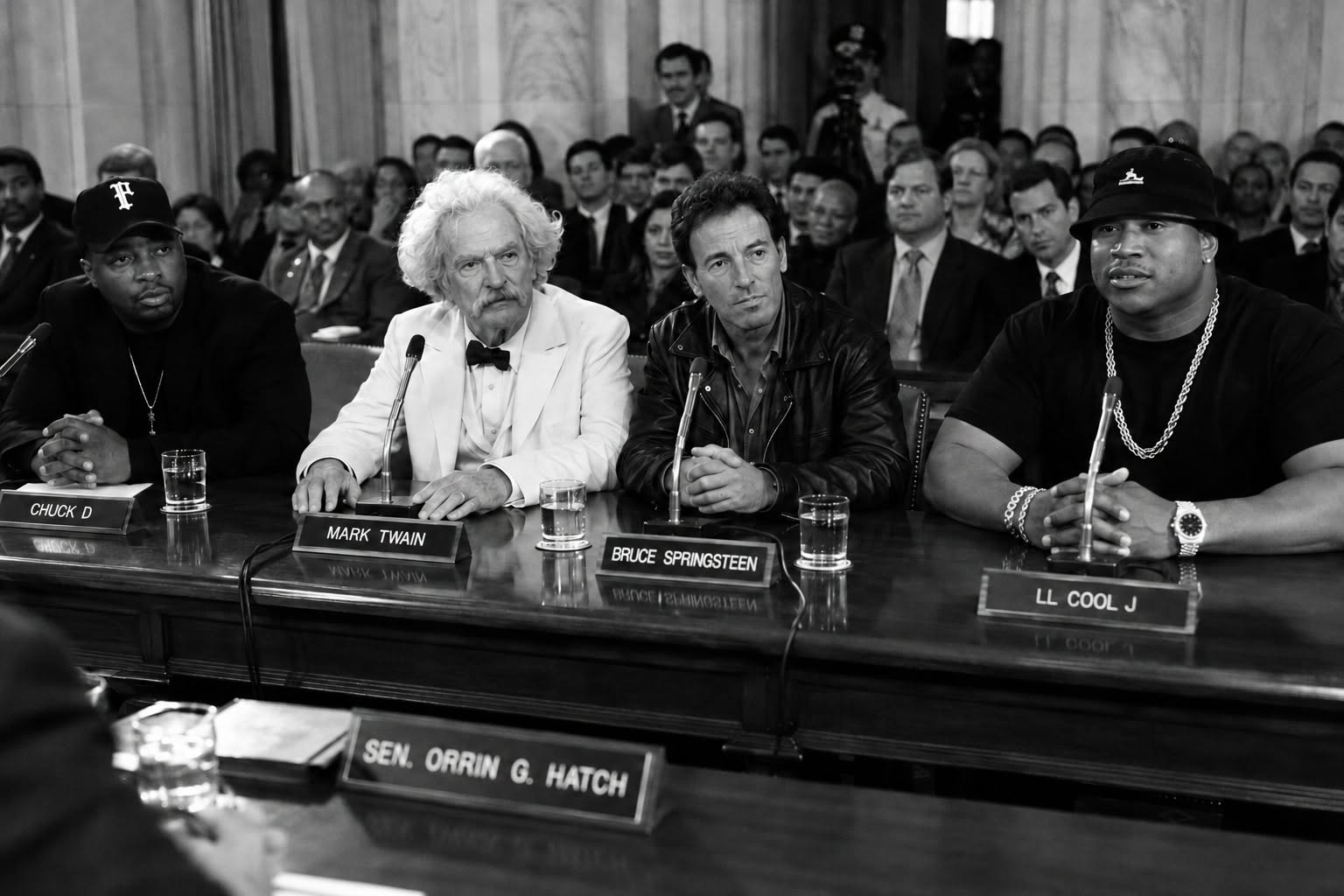
A Recently Discovered Transcript from the Committee Hearing on Modern Lyrics
Washington, D.C. — Declassified 2007
The hearing had already lasted most of the day when the committee decided it needed an outside expert. Members of Congress were arguing over rap lyrics, artistic expression, social commentary, and whether popular music was corrupting America's youth. Witnesses included Chuck D, Bruce Springsteen, LL Cool J, several academics, and a number of elected officials who appeared to regard every musical development since 1958 with deep suspicion.
When the debate reached its sixth hour without producing a single new idea, a government research project was authorized to retrieve a cultural observer from another era.
Moments later, Mark Twain arrived.
Twain was given copies of the lyrics under discussion, several newspaper editorials, and a transcript of the hearing. He spent an hour reading quietly while the committee waited. Finally, the chairman asked whether he had reached a conclusion.
“I have,” Twain replied.
“The poetry appears to be functioning normally. It is the committee that concerns me.”
One member asked whether Twain approved of rap music.
“Approval seems beside the point,” Twain replied. “In my day, people worried that novels would corrupt the young. Before that it was newspapers. Before that it was theater. Before that it was conversation. Humanity has always been alarmed by whatever the younger generation is currently enjoying.”
A second member asked whether the lyrics were too political.
“Sir, I have traveled 130 years into the future. I regret to inform you that politics remains political.”
Twain's final observation: “The music is doing just fine.”
Brought to you by your friend and mine, Guy Schwartz
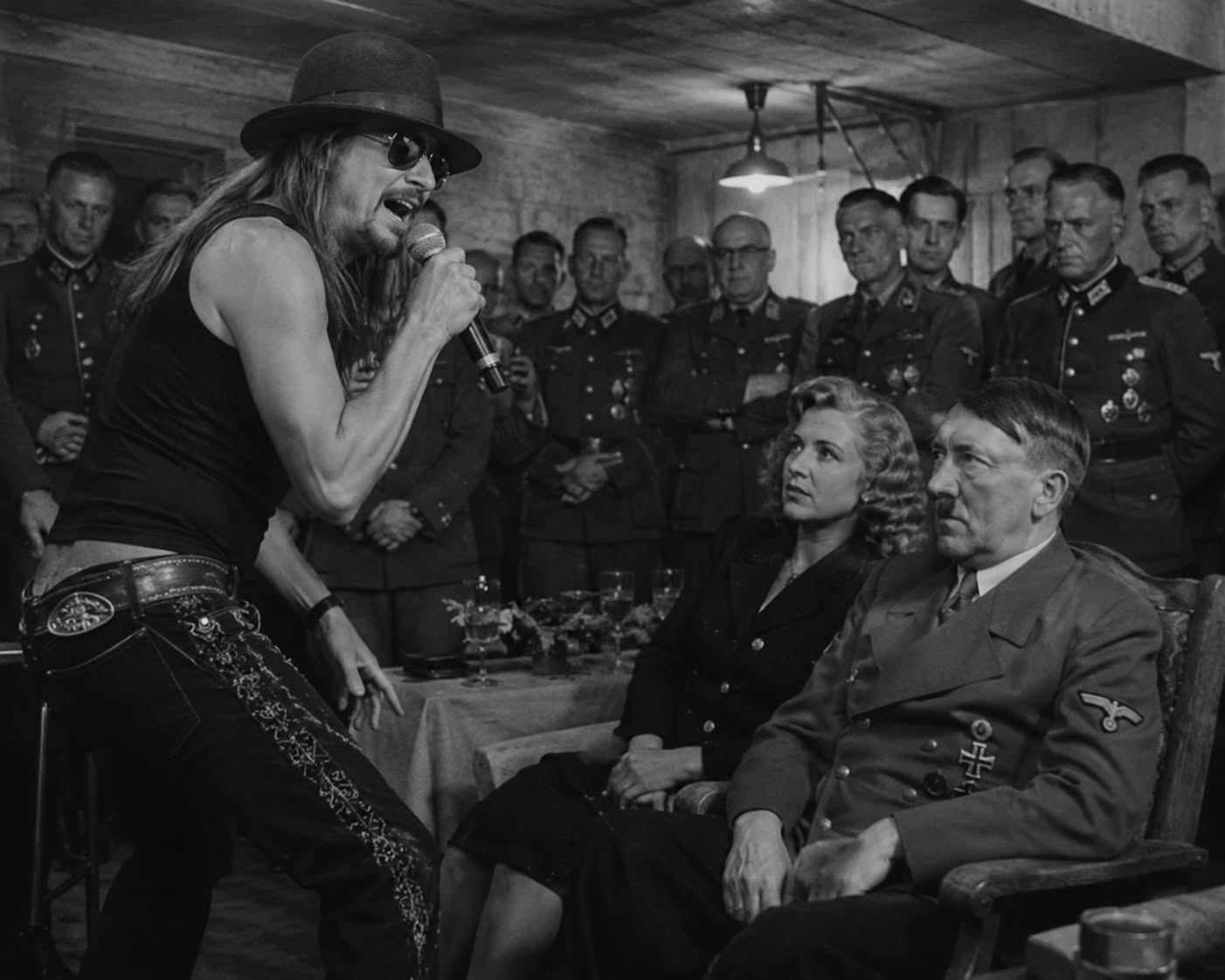
Back in April of 1945, as Berlin crumbled around him and Soviet artillery turned entire city blocks into decorative gravel, Adolf Hitler reportedly withdrew deep into his underground bunker and demanded one final private entertainment performance before the inevitable collapse of the Third Reich.
According to recently fabricated documents, Nazi scientists opened a temporary wormhole behind a Waffle House outside Nashville and transported Kid Rock directly into the Führerbunker. Witnesses described Kid Rock arriving shirtless, carrying a case of Bud Light and asking if anybody wanted to hear “Bawitdaba” twelve consecutive times.
Things reportedly took a terrible turn during the third song, when Kid Rock climbed onto a conference table, pointed at Hitler, and began aggressively twerking in his direction while shouting, “THIS ONE'S FOR BERLIN, BABY!”
Finally Hitler stood up slowly, adjusted his jacket, and whispered, “Nein. Das ist zu viel.”
Roughly twenty minutes later, he decided to end it all.
Historians continue debating many causes for the collapse of the Third Reich, but most now agree the Kid Rock bunker performance probably didn't help.
A True Account of a Temporal Miscalculation and the Conclave That Couldn’t Be Undone
By Fr. Matteo di Verona
Vatican Historical Review
(Declassified 1998)
The story begins not with a prophecy or a vision, but with a scheduling error.
In the spring of 1390, during a period of unrest within the Church, the College of Cardinals gathered in Viterbo to elect a new pope. The conclave, weary of politics and plague, sought a man of humility, strength, and a clear voice.
By a mistake in translation—some say divine mischief—the cardinals believed a petition from “the people of the world” to be a literal request. They were told: “Choose a man whose songs have carried truth farther than the spoken word.”
During this moment of confusion, one name kept rising to the top of the petitions: Lead Belly.
Huddled in candlelight, the cardinals mistook “Lead Belly” for a Latinized saint they had never heard of—Sanctus Vitulus Plumbeus. The vote was unanimous.
When the error was discovered, the conclave had already dissolved. Tradition held: the man once chosen must be brought, wherever he was, and ordained.
Thus began the Most Peculiar Mission in Papal History.
On the Feast of Saints Mark and Wenceslaus (April 25th), three cardinals—Cardinal Orsini, Cardinal d’Este, and Cardinal Carvajal—used an experimental chronometric device, a “tempus transitus,” recently gifted by a mystic scholar from Prague.
Their destination: the future.
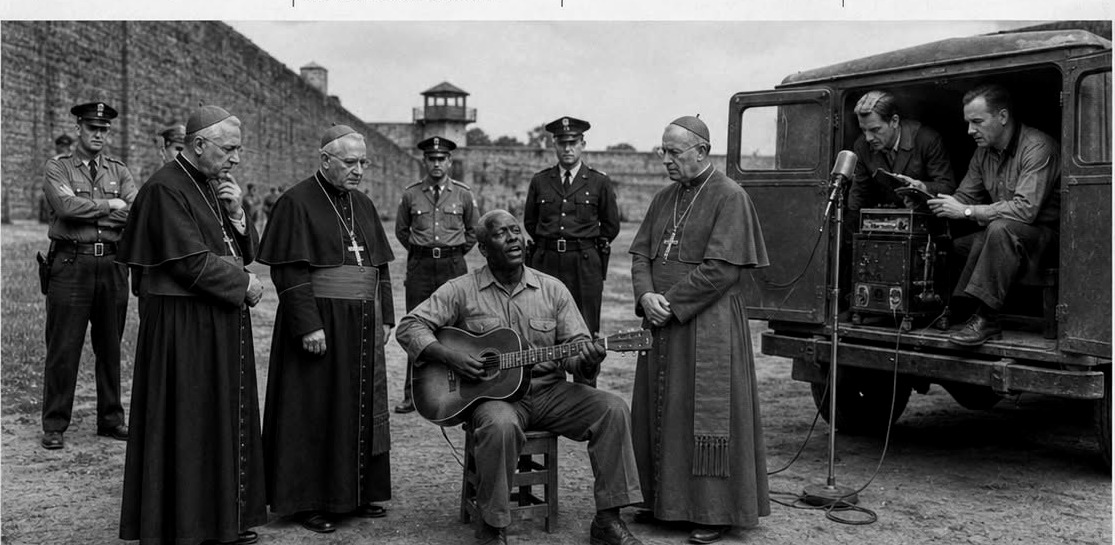
The machine deposited them in the American South, April 1941, within the Angola State Penitentiary in Louisiana.
There, in the prison yard, they found him.
Huddled around his guitar, singing as only he could, was Huddie Ledbetter—known to the world as Lead Belly.
John and Alan Lomax were there, capturing his songs for posterity.
The cardinals, though bewildered by the clothing, the language, and the strange metal box that “swallowed sound,” knew in their hearts they had found their pope.
Lead Belly listened to their plea, counted the number of strings on his guitar, and said:
“I done been in trouble with the law all my life.
If you all think I can handle trouble up there,
I’ll do the best I can.”
He was brought back to Rome, ordained in a whirlwind of awe and confusion, and crowned Pope Leadbetter I on May 12, 1390.
His papacy lasted three-and-a-half years and is remembered as a time of humility, song, and reform. He insisted that all homilies be delivered in plain language and once held a midnight mass that lasted until dawn.
He also introduced the first official Church Blues Choir.
“The Church needed a man who had suffered, repented, and sung the truth. They found him in a prison yard.” — From the Chronicle of Cardinal Orsini
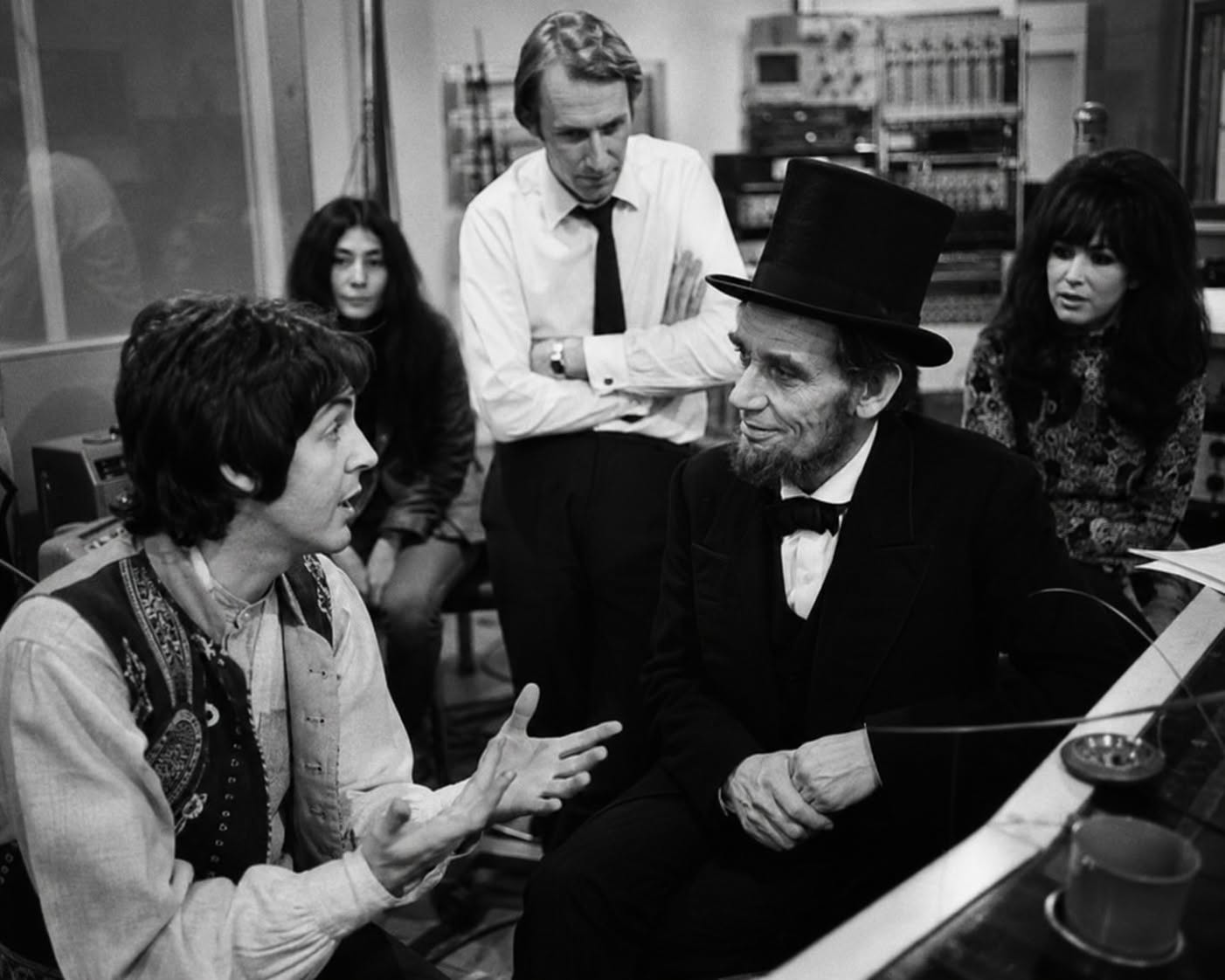
Because history occasionally needs better management
Abe Lincoln pushed open the studio door with that slow, thoughtful gait of his, stovepipe hat entering the room a second before the rest of him. Nobody immediately noticed because it was London in the sixties, and unusual things wandered into recording studios all the time.
Paul McCartney sat at the piano. “No strings,” Paul said firmly. “I hear it simple. Just me, the voice, and the song.” George Martin suggested a quartet.
Lincoln pulled up a chair. “If something is beautiful before you add to it, and remains beautiful afterward, perhaps the question isn't whether something was added. Perhaps the question is whether the addition reveals something already there.”
Ronnie Spector nodded. “Baby, eyeliner doesn't hide your eyes. It frames them.”
The room went silent. George Martin slowly turned toward Ronnie. “My God,” he said, “that's actually brilliant.”
Paul played the melody again. “Alright. Maybe just a quartet.”
Lincoln stood. “My work here is done.”
“Then why are you here?” Paul asked.
“Because history occasionally needs better management.”